
The Preparation Crisis and Waithood: Why Ghana’s Youth Policy Is Misaligned
A Policy Perspective on Ghana’s Youth Transition Crisis
By Gideon Degbe
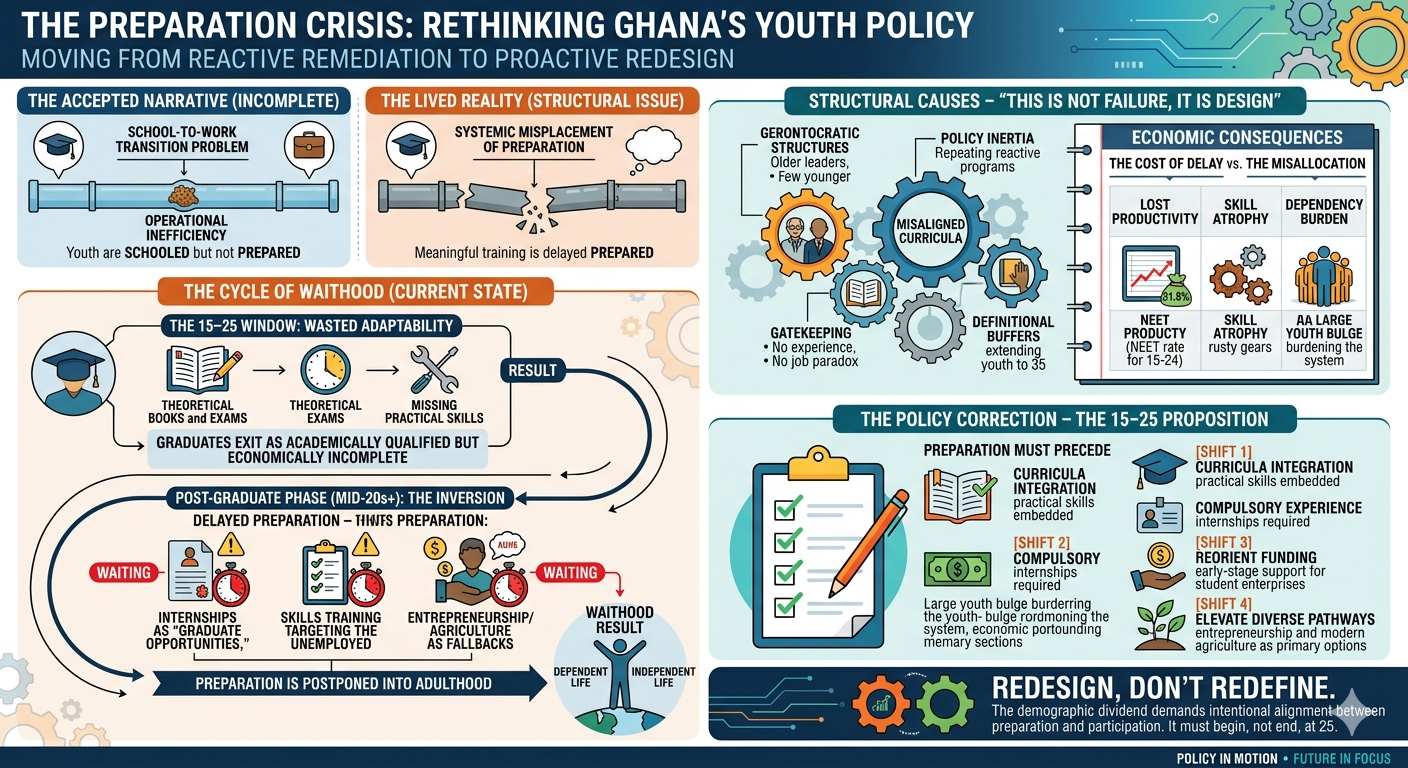
Across Ghana and much of Sub-Saharan Africa, the challenges confronting young people are often framed as a “school-to-work transition” problem a breakdown between education and employment, between preparation and productivity. This framing has become widely accepted among policymakers, educators, and development partners because it suggests that the system is fundamentally sound but experiencing operational inefficiencies that can be addressed through incremental reforms.
It assumes that young people are adequately prepared during their early years and that the primary challenge lies in their inability to transition smoothly into the labour market. Yet, the lived realities of many young people suggest that persistent delays in economic participation, the prolonged periods of uncertainty after graduation, and the increasing dependence on informal pathways all point to a deeper structural issue.
The problem is not simply that young people are not absorbed into the system on time.
The problem is that they are not meaningfully prepared at the right time.
This article advances a more critical thesis: the current youth development framework is characterised by a systemic misplacement of preparation, where meaningful, productivity-oriented training is delayed until after formal education, rather than being embedded within it.
Between the ages of 15 and 25, young people move through Senior High School and tertiary education years that should represent the most intensive phase of preparation for economic participation. These are the years when individuals are most adaptable, most open to learning, and best positioned to experiment, fail, and grow. Yet, in practice, this period is dominated by theoretical, exam-oriented schooling, with limited integration of practical skills, entrepreneurship, agriculture, or real-world economic engagement.
As a result, young people exit this phase not as fully prepared economic actors, but as individuals who must still undergo additional layers of preparation.
This is where the system reveals its core flaw.
Rather than completing preparation within the 15 – 25 window, it postpones it into adulthood. Internships are introduced as “graduate opportunities,” skills training programmes are targeted at the unemployed, and entrepreneurship and agriculture are presented as fallback options after years of unsuccessful job searching. In effect, preparation becomes reactive rather than proactive, and it occurs at a stage when individuals are already expected to be productive.
This inversion creates what can be described as a preparation crisis, a structural condition in which the timing of human capital development is fundamentally misaligned with the timing of economic participation.
The concept of waithood, widely used in African youth studies captures the lived experience of this misalignment as a prolonged period in which young people are neither fully dependent nor fully independent, but are instead navigating uncertainty while waiting for opportunities that should have been accessible earlier.
Rather than addressing this delay, policy responses have tended to adapt to it. The extension of the youth age category to 35 years, as adopted within the African Union framework, reflects an attempt to accommodate prolonged transitions. While this may be justified by socio-economic realities, it also carries a significant implication:
It normalises delayed preparation and delayed productivity, instead of correcting them.
In doing so, the system effectively redefines youth to fit its inefficiencies, rather than redesigning itself to align with the natural progression of human development.
This misalignment is not without consequence as it delays productivity, underutilises human potential, and weakens the overall efficiency of the labour force. More importantly, it raises critical questions about the structure, priorities, and underlying incentives shaping youth policy in Ghana.
If young people are to contribute meaningfully to national development, then preparation must occur before they are expected to perform not after. Until this fundamental shift is made, the cycle of delayed participation, extended dependency, and constrained opportunity will persist, regardless of how youth is defined.
The Intended Development Window (Ages 15 – 25): Where Preparation Should Happen
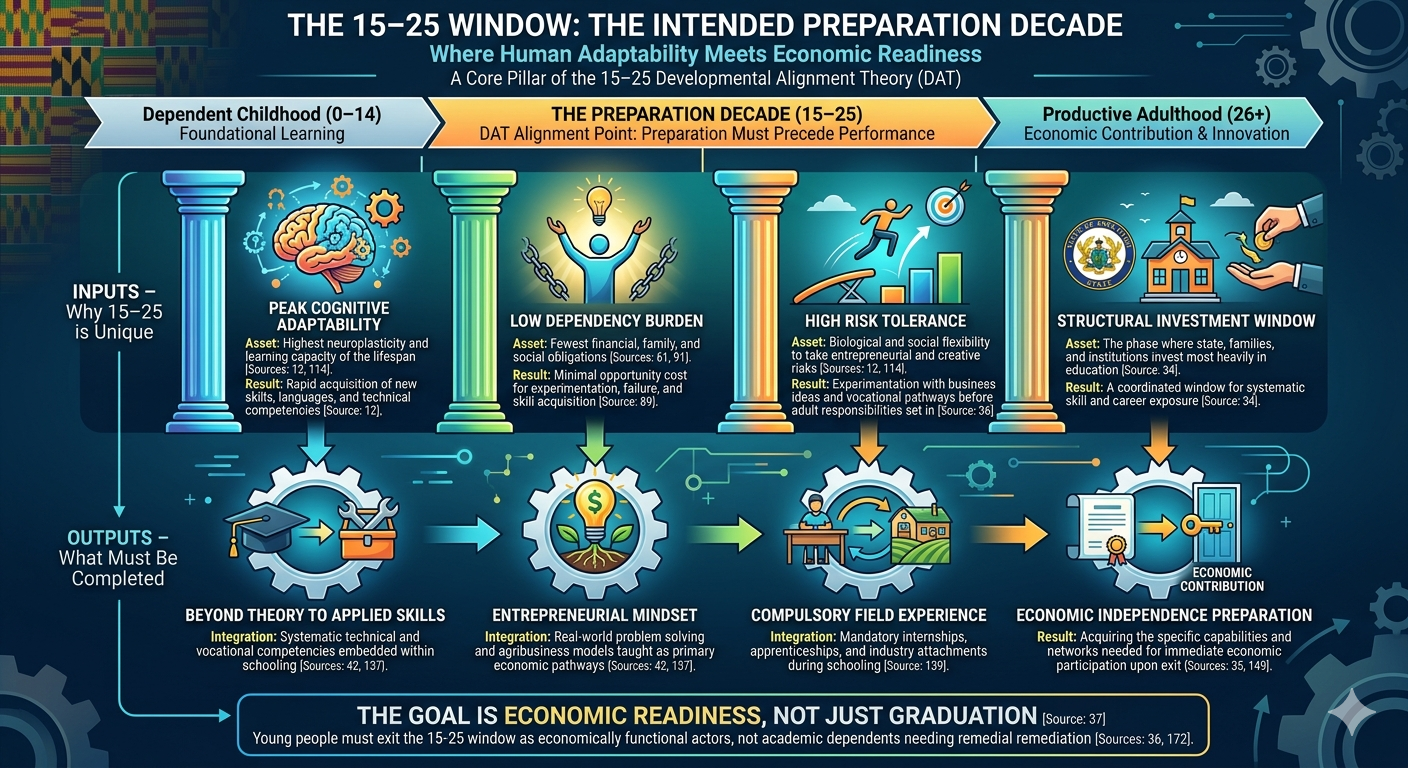
From a human development and economic productivity perspective, the period between ages 15 and 25 is not incidental but foundational. This is the stage at which cognitive capacity matures, identities are formed, and individuals acquire the competencies that shape their lifetime economic trajectory.
In the Ghanaian context, this window aligns almost perfectly with Senior High School (SHS) and subsequent tertiary or vocational education. Structurally, it is the phase during which the state, families, and institutions invest most heavily in young people. By design, this period should function as a complete preparation cycle, one that equips individuals not only with knowledge, but with the practical capabilities, exposure, and pathways required for immediate economic participation.
In an efficient and well-aligned system, the outcome of this phase would be clear:
By the mid-20s, young people should exit education as economically functional actors, capable of entering the workforce, building enterprises, or productively engaging in sectors such as agriculture and industry. The expectation is not simply graduation.
The expectation is readiness for contribution but this intended function of the 15-25 window is not being fulfilled.
Schooling Without Preparation: The Core Structural Failure
In practice, the 15-25 phase in Ghana has evolved into a period of prolonged academic engagement without corresponding practical preparation. While young people spend these years within formal education systems, the dominant focus remains theoretical, exam-oriented, and credential-driven. Systematic exposure to entrepreneurship, technical and vocational competencies, agricultural enterprise, and real-world problem-solving is limited, fragmented, or treated as peripheral rather than central to the learning process. What emerges from this structure is a critical distortion:
Young people are schooled, but not prepared.
Graduates leave SHS and tertiary institutions with certifications that signal educational attainment, yet lack the applied skills, experience, and economic pathways necessary for immediate participation. The system, therefore, produces individuals who are academically qualified but economically incomplete. This distinction is important because what is often described as a “transition problem” is in reality, a preparation failure that occurs earlier in the pipeline.
Delayed Preparation: When the System Trains People Too Late
The misalignment becomes even more evident when one examines when meaningful preparation actually occurs.
Rather than embedding practical training, entrepreneurship, and skills development within the 15 – 25 window, the system shifts these interventions to the post-graduation phase a stage where individuals are already expected to function as economically productive adults.
Internships are widely structured as “graduate programmes,” accessible only after university completion. Skills training initiatives are often targeted at the unemployed. Entrepreneurship and agriculture are frequently introduced not as primary pathways, but as fall-back options after prolonged and unsuccessful job searches, sometimes 5 to 10 years after initial graduation.
This creates a fundamental inversion of the development process:
- The preparation phase (15-25) is underutilised for real economic readiness
- The productivity phase (mid-20s onward) is burdened with delayed preparation
In effect, the system does not fail to transition prepared individuals, rather, it produces unprepared individuals and attempts to prepare them too late.
Preparation becomes reactive rather than proactive, and support systems, funding, training programmes, policy interventions are disproportionately concentrated in the post-education years instead of being embedded within the formative stage where they would yield the highest returns. The consequences of this inversion are not merely individual; they are structural.
At the very point when young people begin to face increasing financial responsibilities and reduced tolerance for risk, they are compelled to re-enter a preparation cycle that should have already been completed. Meanwhile, the years in which they were most adaptable, least burdened, and most capable of experimentation were not fully utilised.
A Structural Pattern, Not a Temporary Gap
This misalignment is not unique to isolated cases but a reflection of a broader structural pattern observable across Ghana and much of Sub-Saharan Africa.
The World Bank has consistently documented prolonged and uncertain school-to-work transitions in the region, highlighting the difficulty young people face in converting education into stable employment. Similarly, the International Labour Organization emphasises that youth unemployment and underemployment in Sub-Saharan Africa are largely structural, not cyclical meaning they are embedded in how systems function, rather than driven by short-term economic fluctuations.
In Ghana specifically, available labour market data continue to show elevated youth unemployment (particularly among ages 15-24), alongside widespread reliance on informal and often low-productivity work among graduates. A significant proportion of young people navigate extended periods of uncertainty before securing stable opportunities.
This lived experience is captured in the concept of waithood, as articulated by Alcinda Honwana is a prolonged condition in which young people are suspended between dependence and full economic adulthood, not due to lack of aspiration or effort, but because systems fail to integrate them at the appropriate time.
The challenge is not that young people are unprepared after 25. It is that they are not prepared before 25 when preparation is supposed to happen. This Is Not Failure It Is Design
The persistence of extended delays in youth economic participation observed consistently across multiple cohorts and spanning several decades cannot reasonably be attributed to temporary disruptions, policy oversights, or cyclical economic shocks. Such regularity points instead to systemic design: an architecture of institutions, incentives, and resource allocations that reliably produces prolonged “waithood” rather than timely productivity.
Several interlocking manifestations illustrate this design:
- Limited creation of productive jobs relative to graduate output:
Ghana produces approximately 300,000 graduates annually from tertiary institutions, yet nearly 60% struggle to secure stable employment. Public sector absorption remains minimal (often below 10% of new graduates), while the private sector and MSMEs have not expanded at a pace sufficient to absorb the skilled labour supply. This imbalance is not new; it has characterised the labour market for years, with structural under-creation of formal, productive roles in sectors capable of leveraging graduate skills.
- Weak alignment between educational curricula and industry or sectoral needs:
Ghana’s education system continues to emphasise theoretical knowledge over practical, market-relevant competencies. Persistent skills mismatches—particularly in technical, digital, vocational, and entrepreneurial areas—mean that many graduates enter the labour market with credentials that do not match employer demands or sectoral opportunities (such as modernised agriculture, hospitality, construction, or emerging digital services). Studies and stakeholder analyses repeatedly highlight outdated curricula, insufficient industry collaboration, and limited integration of hands-on training, resulting in vertical and horizontal mismatches where graduates are either over-educated for available roles or under-skilled for productive ones.
- Gatekeeping via experience requirements even for entry-level roles:
A common barrier is the paradox of “no experience, no job.” Employers frequently demand prior work history for positions that should serve as entry points, effectively excluding fresh graduates and forcing them into prolonged job search or informal, low-productivity activities. This practice protects incumbents and reduces immediate pressure on the system to expand opportunities for new labour market entrants.
- Policy inertia that sustains post-graduation remediation over foundational reform:
Decades of awareness have produced numerous skills-training, entrepreneurship, and youth employment programmes, yet these remain largely reactive. Interventions are often launched or funded only after young people have completed SHS or university and spent years searching unsuccessfully for work. Instead of overhauling SHS and tertiary curricula to embed practical preparation from the outset, the default approach has been to treat the symptoms through later-stage “catch-up” initiatives.
Funding and programmatic emphasis frequently arrive only after prolonged unemployment. At that point, young adults already carrying higher financial and familial responsibilities are advised to “learn a skill,” “start a business,” or “go into agriculture.” These messages, while well-intentioned, arrive at the least efficient moment in the life cycle: when risk tolerance is lower, time for experimentation is constrained, and the opportunity cost of further preparation is highest.
This is basically a pattern that inverts the human development curve. The 15 – 25 window characterised by peak cognitive adaptability, lower dependency burdens, and high capacity for learning through doing is largely squandered on predominantly theoretical schooling. In contrast, the late 20s and 30s when individuals should be establishing economic independence and contributing at scale become burdened with delayed, remedial preparation. Imagine an over 3.5 decayed year old family man or woman (classified as youth) now being prepared for an economic development efficiency project that requires time, energy, innovation and effort. What will be their commitment and effort level? The outcome is not only individual frustration but also national-level under-utilisation of human capital at precisely the stage when it could generate the strongest returns.
The Political Economy of Delay: Gerontocracy and Redefinition
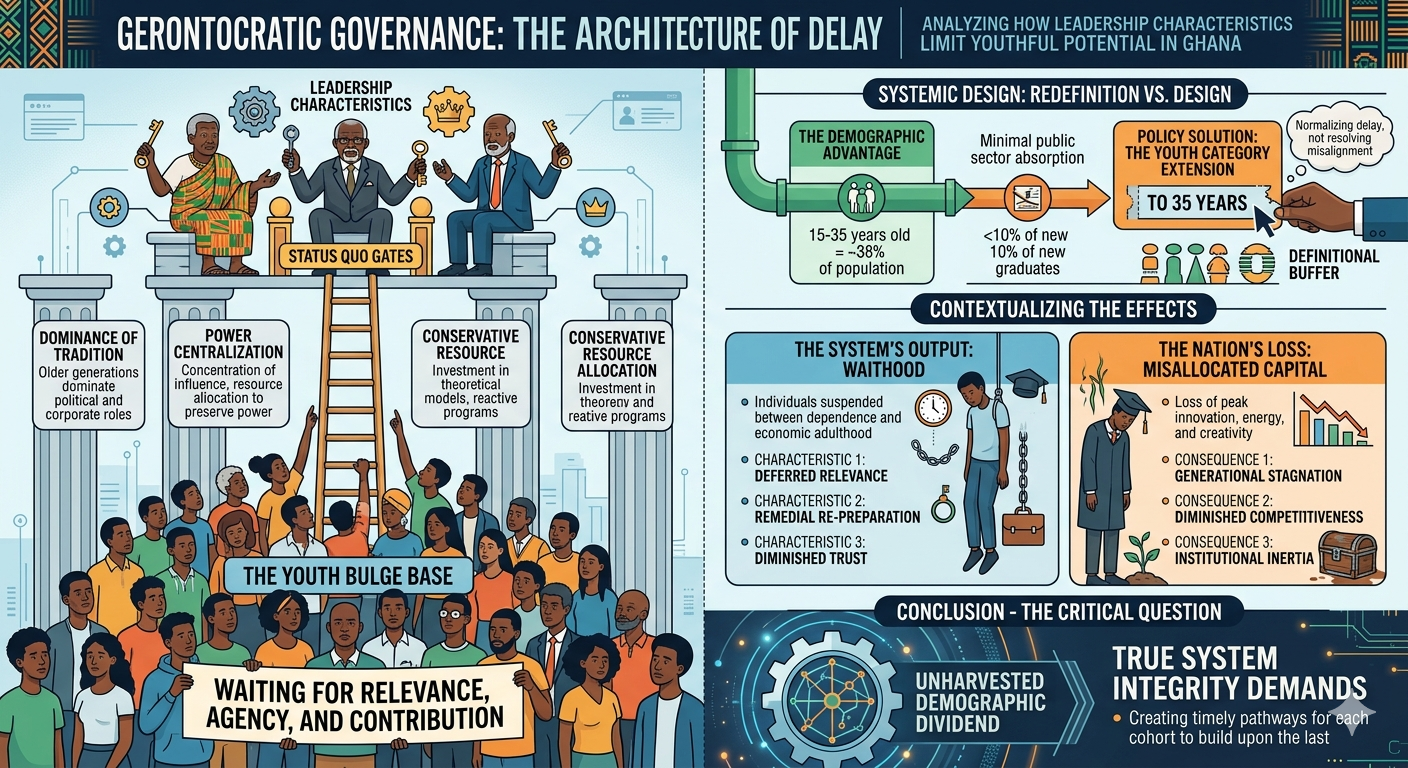
Ghana’s governance structures, consistent with patterns observed across much of Africa, display pronounced gerontocratic features. Older generations continue to dominate key positions in political leadership, corporate boards, public institutions, traditional authorities, and senior civil service roles. This concentration of influence shapes resource allocation, policy priorities, and opportunity structures in ways that often favour continuity over rapid generational renewal.
The African Union’s definition of youth as individuals aged 15-35 years adopted in Ghana’s National Youth Policy (2022- 2032) and aligned with the African Youth Charter originated from a recognition of extended socio-economic transitions in developing contexts. However, in practice, this broader classification carries significant implications beyond its developmental intent. By extending the “youth” label well into the 30s, it normalises delayed entry into full economic participation and leadership. It enlarges the pool categorised as dependent or “in transition,” thereby reducing the perceived urgency for systems to deliver timely opportunities for productive engagement. In effect, it reframes what should be a temporary developmental phase into an extended life stage, reclassifying structural stagnation as a normal feature of youth rather than a policy failure requiring urgent correction.
Redefining youth to accommodate prolonged waithood is therefore not a progressive solution. It functions as a symptom of postponed preparation and as a subtle mechanism that slows generational transition in both political power and economic productivity. When individuals in their early 30s are still officially framed as “youth” needing support, the pressure on established elites to create space through merit-based access, leadership pipelines, or accelerated enterprise opportunities diminishes. This dynamic inadvertently sustains hierarchies that limit the pace at which younger cohorts can assume influential roles, innovate at scale, or drive institutional renewal.
In a country with one of the youngest population structures in the world, where the 15–35 age group constitutes a growing share of the total population (rising from earlier census figures toward 38% in recent data), such redefinition risks converting a potential demographic dividend into a prolonged dependency burden. True policy leadership requires confronting the design elements that delay preparation, rather than adjusting definitional boundaries to fit the resulting delays.
Economic Consequences: Misallocated Human Capital
The costs of Ghana’s preparation crisis and resulting waithood are neither abstract nor merely social, they are measurable, quantifiable, and substantial, representing a profound misallocation of the nation’s most valuable asset: its youthful human capital. By deferring meaningful practical preparation until after the 15 – 25 window, the system squanders peak developmental years and imposes long-term drags on individual trajectories and national progress.
First, lost productivity occurs on a massive scale. The years between 15 and 25 represent the period of highest cognitive flexibility, energy, creativity, and willingness to experiment with new ideas and ventures. When these years are dominated by theoretical schooling followed by prolonged job search or low-productivity informal activities, Ghana forfeits the innovative output, entrepreneurial experimentation, and early labour contributions that could compound into significant economic gains. Recent Ghana Statistical Service data illustrate the scale: in Q3 2025, approximately 1.34 million young people aged 15–24 (21.5% of the cohort) were classified as NEET (not in education, employment, or training) while youth unemployment for this group averaged around 32-34%. In Greater Accra, the rate reached as high as 49%. These idle or underutilised years translate directly into foregone GDP, reduced tax revenues, and missed opportunities for early wealth creation that could fuel consumption, savings, and investment cycles.
Second, skill atrophy and mismatch compound the damage. Skills, like muscles, degrade without timely application. Prolonged delays between acquiring theoretical knowledge and putting it into practice erode technical competence, professional confidence, and the ability to adapt to real-world problem-solving. Graduates who spend 5-10 years searching for stable roles or cycling through unstable informal work often experience a depreciation of their training, leading to lower productivity even when opportunities eventually arise. This mismatch is exacerbated by weak curriculum-industry alignment: many young people emerge with credentials that do not match employer demands in technical, digital, entrepreneurial, or agricultural enterprise skills. The result is not only individual frustration and reduced lifetime earnings but also a broader erosion of returns on the significant public and private investment in education. Instead of building a virtuous cycle of competence and opportunity, the system generates a cycle of discouragement and underperformance.
Third, slower economic growth and higher dependency ratios emerge as systemic drags. Evidence from the IMF and World Bank consistently demonstrates that countries which efficiently absorb young people into productive roles experience stronger per capita GDP growth and faster reductions in poverty. A well-timed youth workforce boosts labour force participation, innovation, and aggregate demand. Conversely, a delayed or mis-timed workforce acts as a brake on national dynamism. In Ghana, where young people (broadly 15-35) constitute a significant and growing share of the population around 38% under age 15 with a large youth bulge the failure to harness this demographic potential converts what could be a dividend into a dependency burden. Higher NEET rates and underemployment increase pressure on public resources (social support, family remittances, and safety nets), while reducing the savings and investment rates needed for capital accumulation. IMF analyses of Sub-Saharan Africa highlight that harnessing the demographic dividend could substantially lift per capita GDP, but only if education, skills, and job creation align effectively precisely the alignment currently undermined by mis-timed preparation.
By systematically misplacing preparation over-academising the high-adaptability 15–25 window while overloading later years with remedial catch-up. Ghana under-invests in its demographic dividend at the exact moment its youthful population structure offers the greatest potential for accelerated, inclusive development. The opportunity cost is measured not only in today’s lost output but in tomorrow’s diminished competitiveness and slower structural transformation.
The 15–25 Proposition: Preparation Must Precede Participation
The policy correction required is both straightforward in concept and transformative in potential impact: Ghana must intentionally redesign its education and youth development systems so that the 15-25 window becomes a genuine, complete preparation phase-where strong academic foundations are deliberately combined with mandatory practical readiness rather than continuing to defer meaningful preparation for economic participation until adulthood.
This redesign shifts from reactive remediation to proactive alignment and demands concrete, structural changes across multiple levels:
- Embedding core practical competencies into curricula: Entrepreneurship, agriculture-as-enterprise (including modern techniques, value addition, and agribusiness models), technical and vocational skills, digital literacy, and real-world problem-solving must become mandatory, integrated core elements of Senior High School and university programmes—not relegated to optional electives or post-graduation add-ons. Curricula should move beyond theory to include project-based learning that simulates market conditions, financial decision-making, and sectoral challenges.
- Making structured practical experience compulsory: Internships, apprenticeships, industry attachments, incubation projects, and mentorship programmes should be required components during schooling, not voluntary or delayed until after graduation. Partnerships with private sector, agricultural cooperatives, and MSMEs can facilitate these experiences, ensuring young people gain hands-on exposure while still in their most adaptable phase.
- Reorienting funding and institutional support: Public and private resources (grants, seed funding, incubation facilities, and technical assistance) must be redirected toward the formative 15–25 years instead of concentrating on reactive post-unemployment programmes. Early-stage funding for student enterprises, school-based agribusiness clubs, or vocational tracks would yield far higher returns than later-stage interventions when risk tolerance and flexibility have already declined.
- Positioning diverse productive pathways as primary options: Formal wage employment should no longer be presented as the sole or superior route. Modernised agriculture, entrepreneurship, and self-employment in high-potential sectors must be elevated as equally viable, prestigious, and supported primary pathways from the outset of secondary education. Career guidance, role models, and success stories should reflect this diversity to reshape aspirations and reduce stigma around non-traditional routes.
If implemented with commitment and coordination across the Ministries of Education, Youth Development, Agriculture, and Trade & Industry, these measures would enable individuals to transition into productive roles earlier often by the mid-20s-achieve economic independence sooner, build confidence through early wins, and contribute meaningfully during their peak energetic and innovative years. Over time, this would reduce the structural pressures that currently necessitate extending the “youth” classification into the 30s, easing the burden on social systems and accelerating generational renewal in leadership and enterprise.
The 15-25 Proposition is not about lowering standards or rushing unprepared youth into the market. It is about honouring the human development curve by ensuring that preparation is completed where it is most efficient before the weight of adult responsibilities sets in thereby unlocking the full potential of Ghana’s demographic advantage.
Beyond Jobs: System Integrity and Generational Equity
This crisis extends far beyond statistics on unemployment or complaints about education quality. At its heart, it is a fundamental question of system integrity: how opportunity is structured, who controls access to pathways of productivity, and whether Ghana’s institutions are genuinely oriented toward collective national development or inadvertently designed to preserve entrenched hierarchies and power balances.
A system that over-emphasises academic credentialing during the 15–25 window—while systematically postponing practical, income-generating preparation until well into adulthood—reveals more than policy gaps. It reflects deliberate institutional, political, and economic choices. Curricula remain heavily theoretical because that model is easier to administer and less disruptive to existing interests. Funding flows toward reactive post-graduation programmes because they create visible “interventions” without challenging upstream structures in secondary and tertiary education. Experience requirements for entry-level roles persist because they shield incumbents from competition. And the extension of the youth category to age 35, as reflected in Ghana’s National Youth Policy (2022-2032) and the African Union framework, provides a convenient administrative label that absorbs pressure rather than resolving the underlying misalignment.
These choices have profound implications for generational equity. In a country where young people aged 15–35 already constitute approximately 38% of the population (with the broader youth bulge continuing to grow), delaying meaningful economic participation slows the natural renewal of leadership, innovation, and decision-making across political, corporate, and institutional spheres. It concentrates influence among older generations, limiting the pace at which fresh perspectives, digital-native competencies, and risk-tolerant entrepreneurial energy can reshape Ghana’s economy and governance.
When preparation is deferred, young Ghanaians do not simply “wait” for jobs-wait for relevance, agency, and the ability to contribute at the level their training and potential suggest. This erodes trust in institutions, fuels frustration, and risks converting a demographic asset into a source of social and political strain. True system integrity demands that institutions serve the long-term interests of the nation by aligning preparation with participation, rather than managing the consequences of misalignment through extended dependency categories or remedial programmes. Generational equity is not about displacing experience with inexperience; it is about creating merit-based, timely pathways so that each cohort can build upon the last rather than competing indefinitely for space in a delayed pipeline.
Conclusion: Redesign, Don’t Redefine
Ghana stands at a critical demographic crossroads. With one of the youngest population structures in the world where young people (broadly 15–35) make up around 38% of the total population and the working-age group continues to expand— the country possesses a historic window for accelerated development. The question before policymakers, administrators, business leaders, and development partners is no longer whether youth matter. The real question is whether we will summon the courage to redesign systems to unlock the full human potential of this youthful population—or continue the easier path of redefining potential and life stages to accommodate inefficient, outdated structures.
The core problem is not that young people are prepared early and absorbed late. The problem is that meaningful preparation for economic participation practical skills, entrepreneurial mindsets, vocational competencies, and real-world exposure is systematically delayed until after they are expected to function as productive adults. This inversion turns the high-adaptability years (15-25) into a period of predominantly theoretical schooling, while burdening the higher-responsibility years (late 20s and 30s) with reactive catch-up training. The result is a predictable cycle: credentialed but under-prepared youth, prolonged waithood, and the administrative convenience of extending “youth” status well into the 30s.
Until this design is confronted head-on, Ghana will continue producing prepared credentials during the youth phase only to manage delayed relevance, under-utilised talent, and foregone productivity during what should be the prime years of economic contribution and innovation.
Policymakers, public administrators, CEOs, and development partners have both the responsibility and the historic opportunity to shift from reactive remediation to proactive redesign. Embedding practical preparation within the 15 – 25 window, reorienting funding and curricula, and creating multiple viable pathways to productivity are not radical ideas they are pragmatic necessities. The demographic dividend will not harvest itself. It demands intentional alignment between preparation and participation beginning, not ending, at 25.
Endnotes
- Ghana Statistical Service. Various quarterly labour statistics reports (2024–2025), including data on youth unemployment (≈32% for ages 15–24) and NEET rates (≈21.5% for ages 15–24 in Q3 2025).
- International Labour Organization. Global Employment Trends for Youth 2024. Geneva: ILO.
- Honwana, A. (2012). The Time of Youth: Work, Social Change, and Politics in Africa. Boulder, CO: Lynne Rienner Publishers.
- World Bank. Reports on youth employment and school-to-work transitions in Sub-Saharan Africa.
- African Union. African Youth Charter and Ghana National Youth Policy (defining youth as 15–35 years).